
Most recently, when fighting erupted in the skies over Kashmir in 1999, at least one Pakistani naval aircraft was downed by an Indian fighter jet. All 16 people aboard were killed.
Pakistan’s military said Wednesday that it shot down two Indian fighter jets that had entered Pakistani airspace, capturing two pilots, in an escalation of hostilities just a day after Indian fighter jets crossed the disputed Kashmir region to launch an airstrike within Pakistan.
India’s government confirmed later Wednesday that one of its MiG-21 fighter jets had been “lost” as it thwarted an attempt by Pakistan’s air force to strike an unspecified target inside India. In the engagement, a Pakistani aircraft was shot down by an Indian fighter jet, New Delhi claimed.
“We have unfortunately lost one MiG-21. The pilot is missing in action. Pakistan has claimed that he is in their custody. We are ascertaining the facts,” Raveesh Kumar said at a news conference in New Delhi, the chief spokesman for India’s Ministry of External Affairs.
Mr. Kumar declined to take any questions and did not respond to claims by Pakistan’s military that it had shot down a second Indian jet. The spokesman did not comment on Pakistan’s claims that it currently held two Indian pilots, instead of the single pilot Mr. Kumar said was missing.
Earlier on Wednesday, Pakistan’s military said it had conducted its first airstrike against unspecified Indian targets, though it said no Pakistani aircraft crossed the border. And the military rejected India’s claim that a Pakistani fighter jet had been shot down.
There are fears that tensions between the nuclear-armed neighbors could escalate after Prime Minister Imran Khan of Pakistan promised on Tuesday to retaliate for an incursion by Indian jets hours before. Those airstrikes were the first time since 1971 that the Indian Air Force had crossed the Line of Control, the de facto border between the Indian- and Pakistani-held areas of Kashmir, to strike inside Pakistan.
Pakistan’s chief military spokesman, Major General Asif Ghafoor, said in a news conference on Wednesday afternoon that Pakistan’s air force had struck six targets inside India, without crossing into the country’s airspace. It was unclear what was struck; Major General Ghafoor described the strikes as being in an open area to make sure there was “no human loss or collateral damage.”
The Indian Air Force responded by entering into Pakistan’s airspace, he added, and two warplanes were shot down.
“Our ground forces arrested two pilots; one of them was injured and has been shifted to C.M.H., and he will be taken care of. The other one is with us,” Major General Ghafoor said, using the initials for the Combined Military Hospital complex.
By Wednesday afternoon, the Indian government shut down the airspace over parts of the country’s north that host military facilities, including Jammu, Srinagar, Amritsar, Leh and Dehradun, according to Rakesh Asthana, the director General of the Bureau of Civil Aviation and Security.
Pakistan also shut down large parts of its airspace, including major airports, according to a notice issued by the country’s Civil Aviation Authority.
Troop movements were reported within both countries, including a tank column that temporarily shut down a highway in the western Indian state of Rajasthan, hundreds of miles south of Kashmir near the border with southern Pakistan.
In a televised speech, Mr. Khan said, “We waited, and today we took action,” shooting down to Indian aircraft after being “forced to retaliate” for the Indian airstrikes on Tuesday. But he asserted he had no desire for war.
“I am talking to India: We need to use wisdom and sagacity. All big wars have been due to miscalculation. No one knew how the war would end,” he said. “My question to India is that given the weapons we have, can we afford miscalculation?”
He added: “We should solve our problems through dialogue.”
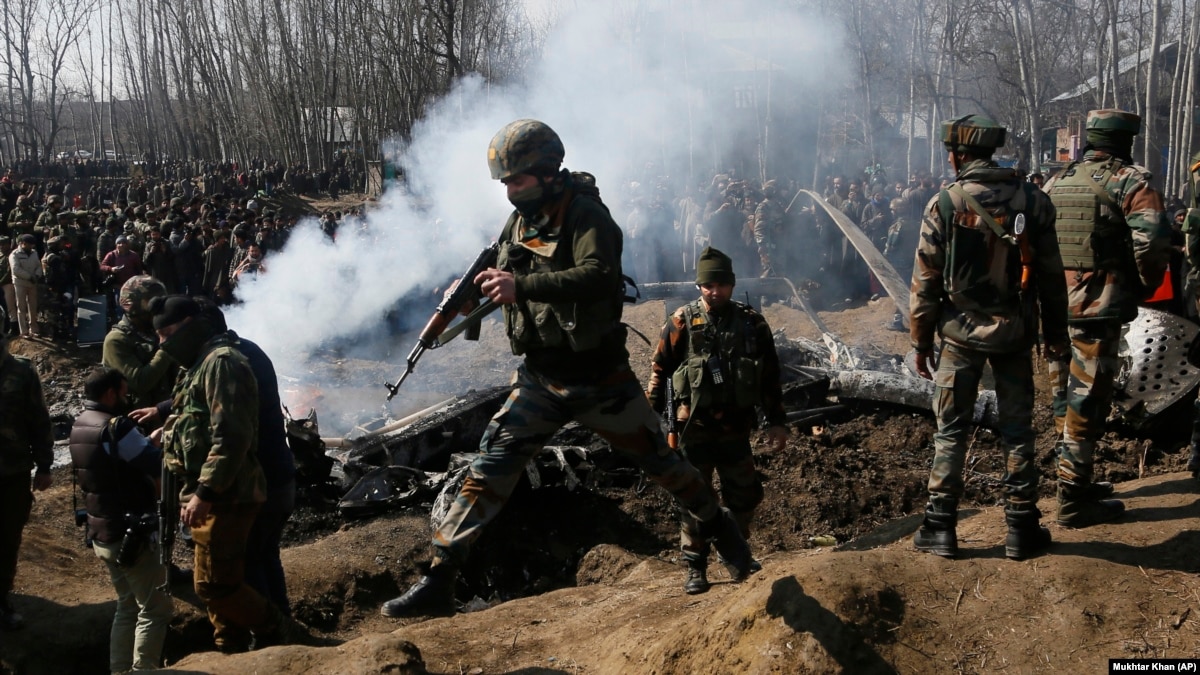
In Indian-controlled Kashmir, residents and officials of Budgam district said that another Indian aircraft — it was unclear whether it was a helicopter or plane — had crashed in an open field there at about 10:15 a.m. local time.
“We have recovered the dead body of the pilot,” said Syed Sehrish Asgar, the deputy commissioner of Budgam district.
Rashid Ahmad Mir, a resident of Budgam, said he heard a loud crash and looked out his window to find smoke billowing out from a nearby field. He rushed to the scene of the flames and found a charred body.
It was unclear whether that crash was related in any way to the air battle reported by Pakistan.
In the early hours of Tuesday morning, India’s Air Force entered Pakistan to strike what the government claimed was a training camp belonging to the Jaish-e-Mohammed militant group in Balakot, Khyber-Pakhtunkwha Province, resulting in “heavy casualties.” But the Pakistani government and residents of the area reached by telephone said the strikes instead struck an open ravine, resulting in minimal damage.
Those strikes were in response to the Feb. 14 suicide bombing by Jaish-e-Mohammed on an Indian paramilitary convoy in Kashmir, which New Delhi vowed to respond to. The suicide bombing killed 40 Indian soldiers, the worst incident in Kashmir in three decades.
Jaish-e-Mohammed is classified as a terrorist group by the United Nations and blacklisted. Although the group is formally banned by Pakistan’s government, American and Indian officials say it operates freely in the country, which Islamabad denies.
In decades of conflict, India and Pakistan have each downed dozens of aircraft. In 1965, during the first major war since Partition, it is estimated that Pakistan destroyed more than 50 Indian aircraft and lost about 20 planes. In 1971, when fighting erupted in East Pakistan, now known as Bangladesh, it is estimated that the Indian Air Force lost more 40 aircraft and the Pakistanis lost more than 70.

No comments:
Post a Comment